Modern marketing teams must make decisions faster than ever. Yet in many organizations, traditional market research still feels like it runs on a flexible deadline. The real question is not only whether research is reliable, but whether it is fast enough to still shape the decision.
That is exactly where the tension sits. Most teams do not want research for research's sake. They want to make a faster choice about positioning, campaign direction, proposition, or audience. If the research only arrives after that choice has already been made in practice, it loses much of its value immediately. Teams that want to speed up the process often end up with a simpler workflow.
Where the delay usually starts
The bottleneck is rarely one big thing. Time is usually lost in many small steps: the brief needs sharpening, the research question goes back for another round, the questionnaire becomes too broad, the audience turns out not to be specific enough, and after fieldwork there is yet another round of interpretation questions. The result is a process that looks logical on paper but has too many moving parts in practice.
On top of that, many teams still treat research as a separate project step. But if every question is handled from scratch, you lose scale. You repeat the same decisions, rebuild context every time, and must explain relevance over and over again. That makes research more expensive in time than it needs to be.
Why that matters more than it used to
Marketing speed has changed. Campaigns launch faster, propositions are adjusted more often, and stakeholders expect shorter turnaround times. As a result, research is increasingly judged by one simple question: does it still help us today? If the answer comes too late, the report may still be correct, but operationally it is already outdated.
That is why the role of research is shifting. It is no longer only about collecting truth after the fact, but about supporting decisions while they are still being made. Research therefore has to be not only correct, but also usable at the pace of the organization.
From one-off project to decision system
The strongest organizations do not treat research as a one-off deliverable, but as a knowledge layer. Results are not only stored, but reused. Benchmarks improve over time, historical insights become valuable, and previous studies help new questions become faster and sharper. That reduces fragmentation and creates more cumulative knowledge.
That is a fundamentally different way of working from the classic project model. Instead of starting over every time, you build a system in which insights accumulate. Each next decision is therefore better supported than the last.
What AI speeds up, and what it does not
AI is not a replacement for good research, but it is a powerful accelerator around it. It can help create a first research setup, sharpen questions, cluster open answers, summarize reports, and surface patterns faster. That creates real time savings, especially in the first analysis and summarization phases.
But AI does not solve everything. If the question is unclear, the audience is wrong, or context is missing, AI mainly accelerates the wrong direction. That is why human expertise is still needed for question framing, methods, sample choices, and final interpretation. Technology can make the process faster, but it does not automatically make it smarter.
Why benchmarks and historical insights make the difference
Raw data is rarely enough. A score only becomes meaningful when you know what to compare it with. Benchmarks make research useful because they show whether something is strong, average, or unusual. Historical insights add another layer: they show whether a brand, audience, or proposition is improving or stalling over time.
That is where much of the real value of modern research sits. Not only in today's measurement, but in the ability to place that measurement next to earlier studies, other markets, and broader patterns. The more that reference layer grows, the faster teams can make better decisions.
What this means in practice for agencies and in-house teams
For agencies, faster research creates room to add research intelligently to existing client work. You can pitch faster, advise better, and work with healthier margins without needing to build a large research team yourself. Research stops being a separate service and becomes a strength inside strategy and client delivery.
For in-house teams, the main benefit is less friction in decision-making. You no longer need to wait for a full report before you can move internally. Faster setup, faster analysis, and clearer benchmarks make research directly usable in campaigns, positioning, and growth plans.
A simpler operating model
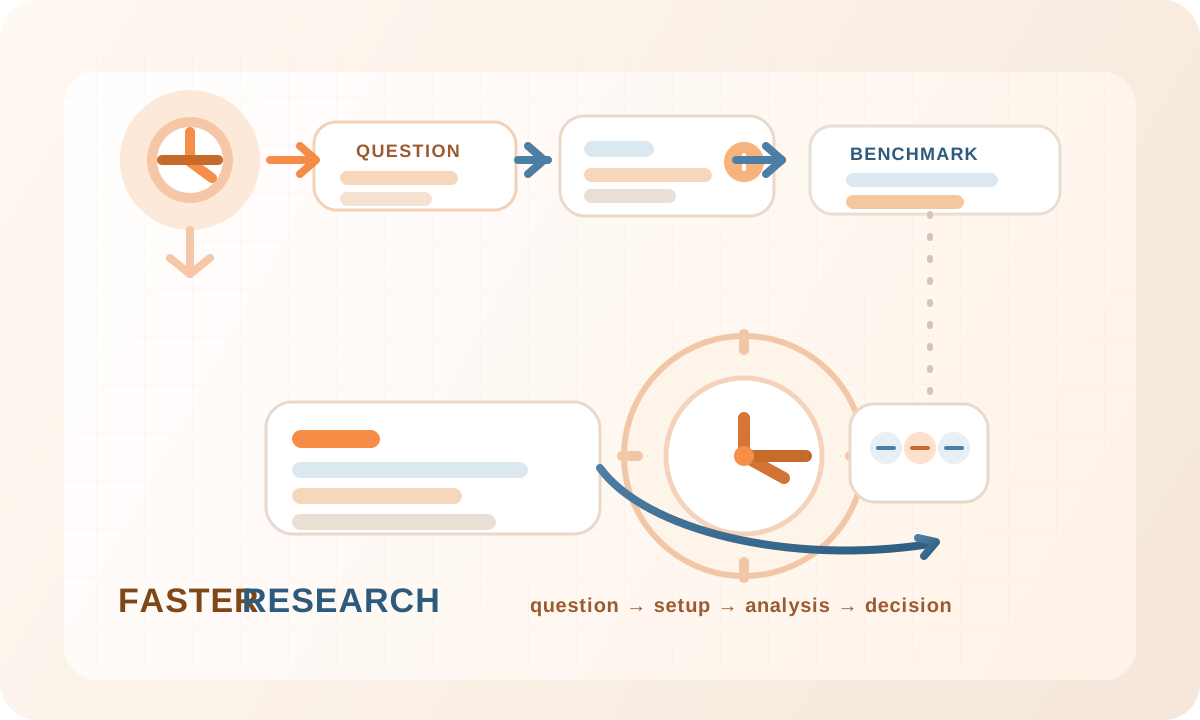
Organizations that do this well usually work with a few clear principles. Start from a concrete decision, not an abstract question. Keep questionnaires compact. Reuse benchmarks and historical data where possible. Automate repetitive steps, but keep human control over interpretation and quality.
That shifts market research from a slow project into a fast decision tool. Not because the content becomes simpler, but because the process is designed more intelligently. That is where the gain for modern teams sits: less noise, more context, and usable insights sooner.
Traditional market research is not disappearing, but its role is changing. The teams that use research faster and smarter do not win because they think less. They win because they organize thinking better. And that is the difference between a report that sits on a shelf and an insight that actually moves a decision forward. If you want to see that in the Stramigo style, you can also read about what Stramigo stands for.