
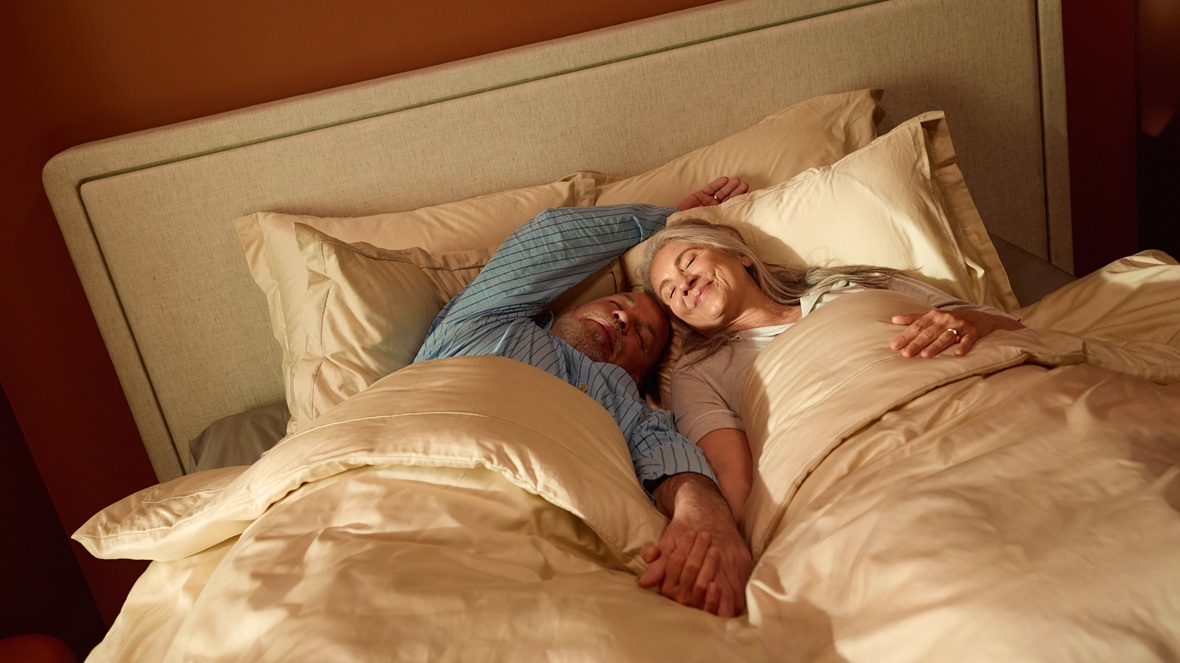
After thirteen years, Beter Bed is bringing back one of its most iconic slogans: ‘Retteketet naar Beter Bed’. Where the line once mainly evoked the mood of deals and price promotions, the pay-off now takes on a contemporary role: a recognisable brand signal and cheerful sign-off to a promise Beter Bed fully delivers on, moving away from purely promotion-driven communication and toward confident choice and sleep expertise.
Stramigo ran an effectiveness study for this campaign among more than 400 respondents, covering key factors such as brand recognition, activation, credibility and irritation.
The campaign taps into a familiar consumer problem that Beter Bed itself links to the FOBO principle, the fear that there is always a better option out there. The commercials show how you can lie awake over all sorts of things, but not over your bed, once you choose Beter Bed’s advice and expertise. To back up that trust, the campaign emphasises distinctive elements such as expert sleep advice, a free body scan, a wide range of products, multiple leading brands and solutions for every budget. Humour keeps the topic light, but the promise is serious: you do not have to figure it out alone.
The return of ‘Retteketet’ as a recognition hook
The interesting question with a comeback like this is not whether the slogan is “nostalgically nice”, but whether it genuinely works again today. Does ‘Retteketet naar Beter Bed’ contribute to brand recognition, brand recall and the overall effectiveness of the campaign?
The test data shows an important signal: viewers spontaneously mention the slogan in their first thoughts, without being explicitly asked about it. Responses like “Nice that the slogan is back! Retteketet.” and “Still love that Retteketet naar Beterbed!” show that the line is picked up and repeated immediately. That is exactly what you hope for when bringing back an iconic brand signal: not just seen, but said back.
“Nice use of the old slogan.” It sounds small, but it is actually strong evidence that the campaign activates a recognisable memory hook in a short amount of time. In a category where many brands speak the same language about comfort, support and a good night’s sleep, one consistent, distinctive element can make the difference between “just another bed commercial” and “oh right, this is Beter Bed”.
“For us, the return of ‘Retteketet’ was more than a nod to the past. We believe in the power of a recognisable brand signal, and it also fits perfectly with a time when consumers are craving trust and familiarity.”
“In a category where consumers deliberate for a long time and compare a lot, an element like this helps them make the connection to the brand faster. Fortunately, the first results show that consumers spontaneously give the pay-off right back to us. For us, that might be the best possible confirmation that consistent brand building works.”
Steffy ClephasMarketing manager at Beter Bed
What else stands out strongly in the tests
A second strength is how clearly the campaign positions Beter Bed as a guide in the decision process. In the open-ended answers, people regularly reflect back exactly what the brand set out to achieve: “The message is clear. You need to go to Beter Bed for a good mattress.” and “Clear who’s behind it.” Comments like these are more than a compliment. They point to a clear sender, little noise, and a message that does not get lost in the joke.
It is also notable that the new campaign is activating. The ads drive people to action more strongly than both the TV commercials benchmark and the Retail benchmark. That is exactly what you want in a category where procrastination is often the biggest competitor. The open-ended answers show how that plays out too. “Informative, I’m going to check how long I’ve had my mattress” and “Fun ad, it makes you think right away about how old my mattress is.” These are small shifts in behaviour and attention, but they matter: from passive viewing to active consideration.

On credibility too, the campaign line shows a foundation that can carry weight, especially in the execution that most directly links the advice and the scan to the decision problem. There, the campaign scores above the TV commercials and Retail benchmarks. In another execution, credibility is a bit more average and falls below those benchmarks, which fits with feedback where the format is somewhat more distracting. The upside is that Beter Bed is not forcing a single tone here. The campaign has multiple angles under one recognisable roof, allowing for rotation, learning and refinement without losing recognisability.
Finally, the campaign holds up well on distinctiveness. That score is around the level of the TV commercials benchmark and in line with Retail. It is a signal that the combination of humour, proof of service and the returning slogan gives it enough character to avoid blending into category conventions.
The key nuance: preventing irritation and wear-out
Building recognisability sometimes comes with a downside. On irritation, the campaign scores above the TV commercials and Retail benchmarks. That means the commercials are found more irritating than average.
That does not necessarily mean the campaign is not working. On the contrary: distinctive campaigns often stick better precisely because they have their own rhythm and repetition. But it is a signal to stay alert to wear-out as contact frequency increases. Variation in edits, smart rotation of executions and careful pacing make the difference here. That way, ‘Retteketet’ stays a warm brand signal rather than becoming the reason people tune out.
Lessons for marketers
-
1
Recognisable brand signals speed up brand recall, but only if people start repeating them themselves.
The most convincing proof of a strong brand signal is not that it is “in there”, but that it “comes back out” from the audience. The spontaneous ‘Retteketet’ responses show that a recognisable slogan can jump back into memory, even in a modern campaign context. For marketers, this is a reminder: build around one or a few recognisable elements and use them consistently, for long enough, without frills.
-
2
Nostalgia opens the door, but proof and relevance keep people there.
A comeback can quickly feel like a gimmick unless you tie it to a problem that matters today and back it up with something tangible. Beter Bed does this by connecting doubt around buying a mattress to concrete proof of service, such as the scan, advice and trial lying. The lesson: nostalgia is attention, but modern proof is what drives conviction and action.
-
3
If you stand out, irritation can rise with it. That is when campaign discipline is your best friend.
The campaign is found more irritating than average. That is exactly the moment when variation, rotation and frequency planning make the difference between recognition that works and recognition that wears out. For marketers, this means: design your campaign as a system with multiple versions, so you retain recognisability without wearing people down.
Beter Bed shows how a slogan once mainly used to drive promotions can be redeployed as a strategic tool for trust and confident choice. Or, as viewers themselves now write down almost without thinking: “Retteketet naar Beter Bed.” That is not just nostalgia. That is a reflex again.